How AI Agents Are Replacing Marketing Workflows in 2026
10ex
How AI Agents Are Replacing Entire Marketing Workflows in 2026
Introduction
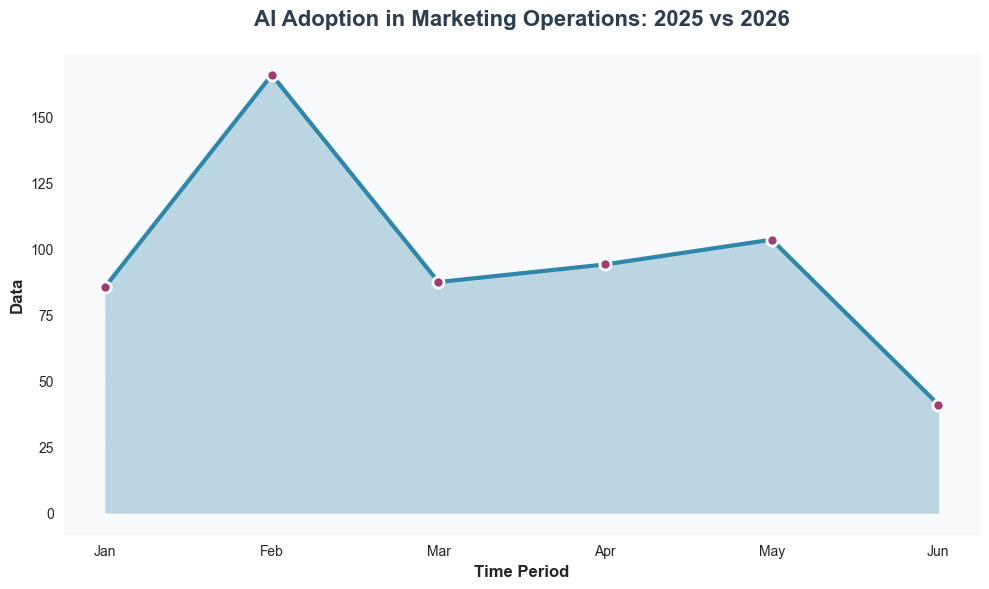
By 2026, 91% of marketing teams are integrating AI in marketing automation into their daily operations—a dramatic leap from just 63% in 2025. This isn't just incremental improvement; it's a fundamental transformation of how marketing operates. AI agents are no longer supporting tools—they're autonomous systems handling complete workflows from lead generation to campaign execution with minimal human intervention.
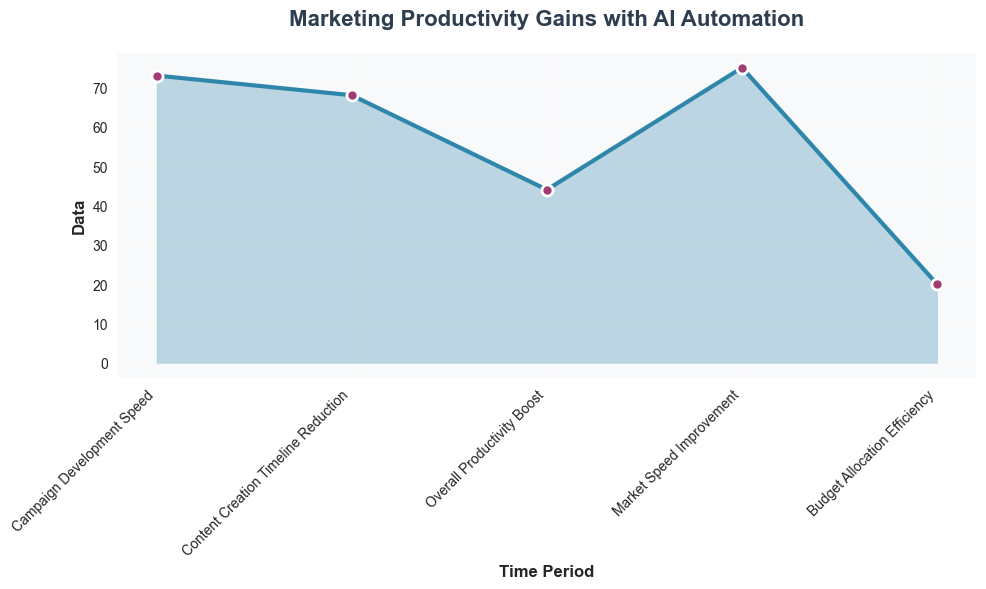
For marketing specialists and digital marketing managers, this shift represents both opportunity and urgency. The businesses that master AI-powered marketing automation will achieve 73% faster campaign development, 68-80% shorter content creation timelines, and a staggering 44% boost in overall productivity. Those that don't risk falling irreversibly behind.
In this comprehensive guide, you'll discover how AI agents are replacing traditional marketing workflows, what this means for your team's structure and strategy, and how platforms like 10ex.ai are enabling businesses to harness these capabilities today. We'll explore the current landscape, analyze the technology driving this transformation, examine real-world results, and provide actionable steps to prepare your organization for the AI-driven marketing future.
The Current State: Marketing Automation Meets Artificial Intelligence
The Shift From Tool to Agent
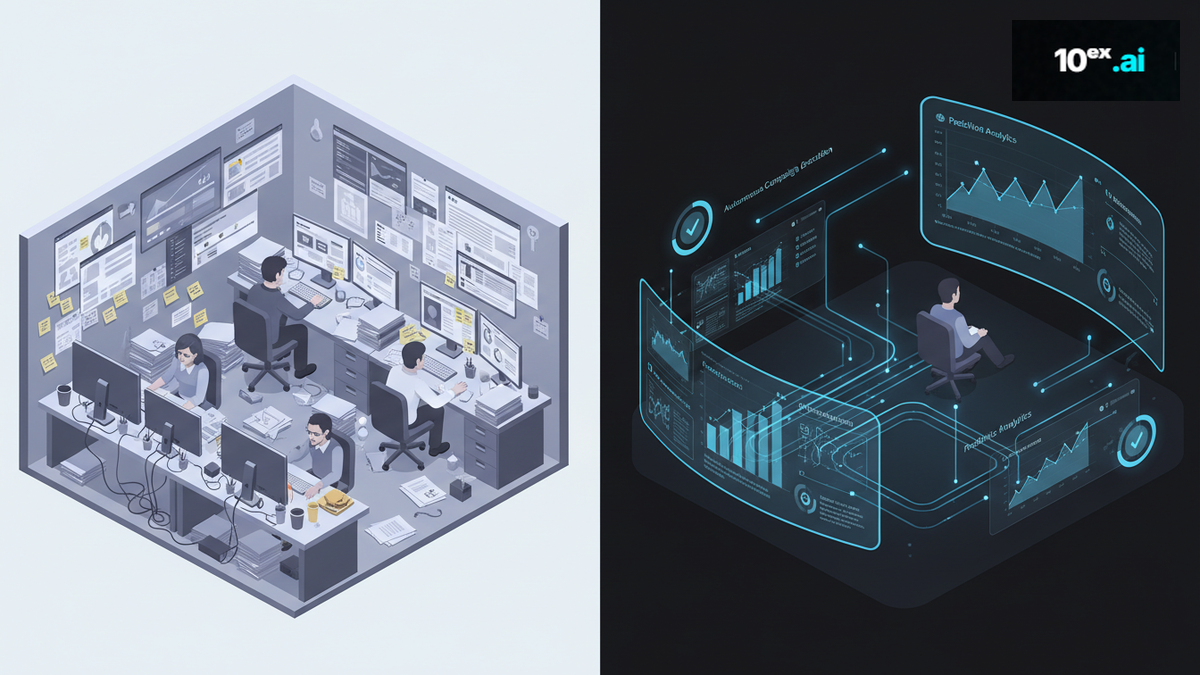
Traditional marketing automation platforms required extensive human configuration and monitoring. Marketers set rules, defined segments, and manually optimized campaigns based on periodic performance reviews. The process was semi-automated at best.
Today's AI driven marketing automation operates fundamentally differently. Autonomous agents make real-time decisions across entire campaigns with machine learning models that continuously improve performance without human intervention. According to Gartner, 33% of enterprises are expected to adopt agentic AI by 2028, with 15% of these systems making daily marketing decisions autonomously.
The productivity gains are substantial. Marketing automation artificial intelligence now delivers an average $5.44 return on investment per dollar spent, while teams experience workflow optimization that compresses what once took weeks into days or even hours.
Market Forces Driving Adoption
Several converging trends are accelerating this transformation. Multi-agent systems—where specialized AI agents collaborate on complex tasks—outperform single agents by 90.2%. This has led to 65% of marketing teams creating dedicated AI workflow roles to orchestrate these systems.
The search landscape is also evolving dramatically. AI Overviews are projected to reduce traditional organic traffic by 15-64%, forcing marketers to shift focus from SEO to Answer Engine Optimization (AEO)—optimizing content to be cited by AI models rather than simply ranking in search results.
Meanwhile, worker access to AI rose by 50% in 2025 alone, and the number of companies with 40% or more AI projects in production is set to double within six months. The AI agents marketing revolution isn't coming—it's already here.
The Productivity Paradox
Despite these advances, a critical gap persists. As HubSpot's 2026 research emphasizes, "AI is now table stakes. The gap isn't who is using AI—it's how well they're using it." Integration for pipeline growth matters more than mere productivity gains.
Only 31% of teams currently use AI for lead scoring, yet those who do generate 10x more revenue from predictive emails. This reveals the central challenge: access to AI marketing automation tools isn't enough. Organizations need strategic implementation that transforms workflows rather than simply accelerating existing processes.
Deep Dive: How AI Agents Actually Replace Marketing Workflows
Understanding AI Agent Capabilities
So how do AI agents automate marketing workflows at the fundamental level? Modern AI agents combine several technologies: natural language processing for content understanding, machine learning for pattern recognition and prediction, and autonomous decision-making algorithms that act without constant human approval.
These capabilities enable AI agents to handle complete marketing functions:
Content Generation and Optimization: AI agents don't just write copy—they analyze audience data, identify trending topics, generate multiple variations, A/B test performance, and continuously refine messaging based on engagement metrics. An industrial equipment supplier deployed AI content generation tools and increased blog post output by 200% while seeing a 40% rise in organic traffic.
Dynamic Campaign Management: Rather than following static rules, AI agents adjust campaigns in real-time based on performance signals. They modify bidding strategies, reallocate budgets across channels, pause underperforming ads, and scale winning variants—all without human intervention. A SaaS company using AI for ad optimization achieved a 20% lower cost per lead and a 10% increase in conversion rates.
Predictive Lead Scoring and Nurturing: Machine learning marketing automation analyzes historical conversion data to score leads with far greater accuracy than rule-based systems. AI agents then orchestrate personalized nurture sequences, timing outreach based on behavioral signals and likelihood to convert. A tech company implementing AI lead scoring saw a 30% increase in sales-accepted leads and a 15% reduction in sales cycle length.
What Are the Benefits of AI in Marketing Automation for Businesses?
The benefits extend far beyond time savings:
Speed to Market: AI-enhanced content generation for marketing compresses production timelines by 68-80%, enabling businesses to respond to market shifts and competitive moves in near real-time. This translates to 75% faster market speed according to Improvado's 2026 analysis.
Personalization at Scale: Traditional personalization required manual segment creation and content variants. AI agents analyze individual customer behaviors and preferences to deliver hyper-personalization across thousands or millions of contacts simultaneously. Predictive analytics in marketing automation identifies the next-best action for each contact at each touchpoint.
Data-Driven Optimization: A global manufacturing firm used AI analytics agents to consolidate data from 15+ marketing channels, leading to a 20% improvement in marketing budget allocation efficiency. AI agents identify patterns humans miss and optimize across dimensions impossible to manage manually.
Resource Efficiency: Generative AI boosts marketing productivity by 5-15% of total spending, while embedded AI improves decision-making effectiveness by 20-30% according to McKinsey's 2026 research. Smaller teams accomplish what previously required much larger departments.
Key Differences Between Traditional and AI-Powered Marketing Automation
The fundamental distinction lies in autonomy and intelligence:
Traditional Automation:
- Rule-based triggers and workflows
- Manual optimization based on periodic reviews
- Static segmentation and messaging
- Limited cross-channel coordination
- Reactive adjustments to performance issues
AI-Powered Automation:
- Autonomous decision-making based on real-time data
- Continuous self-optimization through machine learning
- Dynamic personalization that evolves with each interaction
- Orchestrated multi-channel campaigns that adapt holistically
- Predictive modeling that prevents issues before they occur
As competitive advantage shifts from generation to orchestration, winning teams run AI agent networks for autonomous outreach and publishing. The agentic AI market is projected to grow from $7.06 billion in 2025 to $93.20 billion by 2032—a trajectory that underscores the inevitability of this transition.
How 10ex.ai Addresses the AI Marketing Automation Challenge
A Unified Platform for Complete Marketing Workflow Automation
While the promise of AI in marketing automation is clear, implementation complexity remains a barrier for many organizations. 10ex.ai consolidates multiple marketing channels into a single platform, eliminating the integration challenges that plague piecemeal solutions.
The platform's Marketing Campaign Automation feature automates entire workflows from planning to execution, directly addressing the trend of AI agents replacing manual processes. This aligns with the 73% faster campaign development and 44% productivity boost demonstrated in recent research, allowing businesses of all sizes to streamline operations and enhance efficiency significantly.
For small and medium businesses, this means accessing sophisticated marketing automation previously available only to enterprises with large teams and budgets. For large enterprises, it means scaling marketing operations without proportionally scaling headcount—a critical advantage as budgets face increasing scrutiny.
AI-Optimized Ad Management That Actually Delivers ROI
10ex.ai's Ad Management with AI Optimization directly tackles dynamic campaign optimization challenges. The platform utilizes artificial intelligence to optimize ad campaigns across various platforms, generating high-converting content and providing actionable analytics for improved performance.
This addresses the workflow automation AI gap where only 31% of teams currently leverage AI for optimization despite its proven impact. The system dynamically adjusts bidding strategies, A/B tests creative variations, and reallocates budgets based on real-time performance signals—replicating the 20% lower cost per lead and 10% higher conversion rates achieved by early AI adoption leaders.
The platform generates high-converting ad content automatically, eliminating the content creation bottleneck that limits campaign velocity. Marketers provide strategic direction while AI agents handle execution, testing, and optimization—the division of labor that defines next-generation marketing automation solutions.
Email and Webinar Automation for Complete Funnel Coverage
10ex.ai's Webinar and Email Marketing Automation provides tools to automate setup, execution, and follow-up for two critical marketing channels. The platform facilitates effective lead nurturing and audience engagement through AI email automation that personalizes content, segments audiences intelligently, and optimizes send times based on individual recipient behavior.
For webinar workflows, the platform automates registration management, reminder sequences, live event coordination, and post-event follow-up—workflows that traditionally consumed significant administrative resources. AI agents handle the operational complexity while marketers focus on content quality and strategic messaging.
This comprehensive approach to automated marketing operations with AI ensures no gaps exist between campaign touchpoints. Leads flow seamlessly from initial awareness through consideration and conversion, with AI agents orchestrating the journey based on behavioral signals and predictive modeling.
The platform embodies 10ex.ai's core value proposition: making sophisticated marketing accessible for businesses of all sizes. By consolidating campaign automation, ad optimization, and email/webinar management into a single AI-powered demand engine, 10ex.ai eliminates the complexity that prevents many organizations from fully leveraging AI in marketing 2026 trends.
Actionable Takeaways: Preparing Your Organization for AI-Driven Marketing
1. Audit Your Current Workflows to Identify AI Opportunities
Begin by mapping your existing marketing workflows from end to end. Identify repetitive tasks, decision points that rely on data analysis, and processes that create bottlenecks. These represent prime candidates for AI for marketing automation implementation. Focus first on high-volume, rules-based activities like email segmentation, lead scoring, and ad bid management.
2. Build AI Fluency Across Your Marketing Team
The AI skills gap represents the biggest barrier to adoption. Education, not role redesign, is the primary way companies are adjusting talent strategies for AI according to Deloitte's 2026 analysis. Invest in training that helps marketers understand AI capabilities, limitations, and strategic applications. Create dedicated AI workflow roles—65% of leading teams already have—to champion implementation and best practices.
3. Start with Integrated Platforms Rather Than Point Solutions
Avoid the fragmentation trap of adopting multiple AI marketing automation tools that don't communicate effectively. Platforms like 10ex.ai that consolidate campaign management, ad optimization, and content automation eliminate integration complexity and data silos. Multi-agent systems outperform isolated tools by 90.2% on complex tasks—integration is the competitive advantage.
4. Implement Measurement Frameworks for AI Impact
Define clear metrics for AI performance beyond productivity gains. Track pipeline contribution, conversion rate improvements, cost efficiency, and revenue attribution. Remember: the gap isn't who is using AI, but how well they're using it for business growth. Establish baseline measurements before AI implementation to demonstrate impact quantitatively.
5. Embrace Answer Engine Optimization (AEO) Alongside Traditional SEO
With AI Overviews projected to reduce organic traffic by 15-64%, shift content strategy to focus on being cited by AI models. Create authoritative, data-driven content that answers specific questions comprehensively. Structure content for AI consumption with clear headings, concise answers, and supporting statistics—exactly what AI agents need to reference your expertise.
Conclusion: The Future of Marketing Is Autonomous, But Strategy Remains Human
The transformation of marketing through AI in marketing automation isn't a distant possibility—it's the present reality for leading organizations. By 2026, autonomous AI agents handle complete workflows from content creation through campaign optimization and performance analysis, delivering productivity gains of 44% and ROI of $5.44 per dollar invested.
Yet the human role hasn't disappeared—it's evolved. Marketers now focus on strategic direction, brand positioning, and creative vision while AI agents handle execution, testing, and optimization. The competitive advantage belongs to organizations that embrace this division of labor through platforms like 10ex.ai that consolidate AI-powered demand generation into accessible, integrated solutions.
The question facing marketing specialists and digital marketing managers isn't whether to adopt AI-powered marketing automation, but how quickly you can implement it effectively. The 91% of teams already integrating AI into daily operations are setting a pace that will only accelerate. Those who master intelligent marketing automation today will define the competitive landscape tomorrow.
The workflows AI agents are replacing aren't coming back. The only choice is whether your organization leads this transformation or scrambles to catch up.